


 English
 Español
 Deutsch


A stripped wire end left bare inside a terminal block corrodes at its own pace, invisible until a connection starts running warm or a control panel throws an intermittent fault. Electrical wire terminals exist to close off that exposure, consolidating loose strands into a single, protected contact point that a screw terminal, spring clamp, or PCB header can grip reliably. The base metal and the plating layered over it do the bulk of the work here, and the choice behind both says a good deal about how a terminal will hold up once it is actually installed. Yueqing Chaodao Electrical Connection Co., Ltd. builds its electrical wire terminals range around this same pairing of base metal and surface treatment across every terminal shape it produces.
Copper and Brass Form the Conductive Core
A large share of electrical wire terminals are machined or stamped from copper or brass, materials chosen for the combination of conductivity and mechanical strength stranded wire termination calls for. Copper carries current with comparatively little resistance, while brass adds stiffness that helps a terminal hold its crimped shape under repeated handling and vibration. Yueqing Chaodao Electrical Connection Co., Ltd. sources this base metal to match the terminal's intended current rating, matching wall thickness and barrel diameter to the wire gauge range each terminal series is built to serve.
Tin and Nickel Plating Extend Service Life
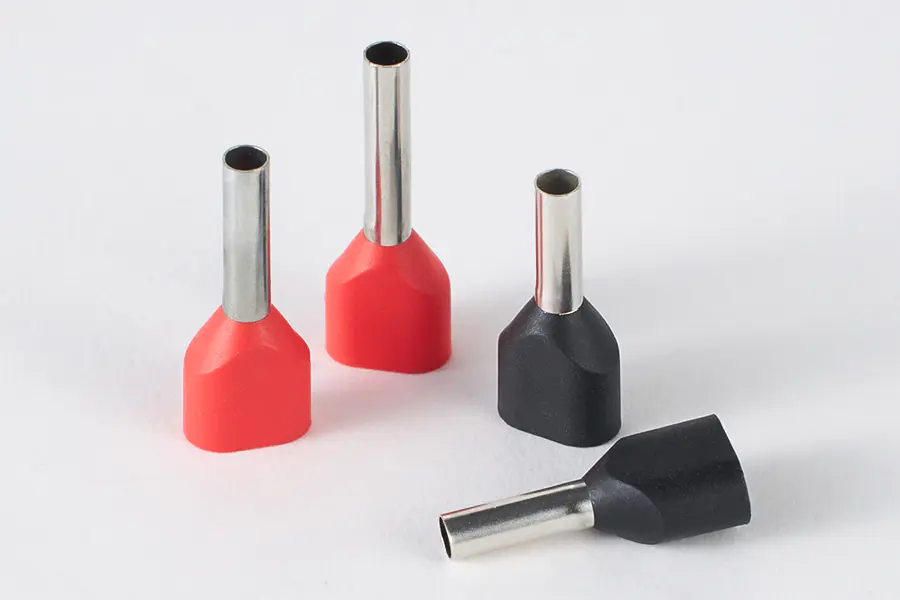
A bare copper or brass surface oxidizes steadily once exposed to air, and that oxide layer is what raises contact resistance over time even when the underlying metal is otherwise sound. A tin plated copper terminal carries a thin barrier layer that slows this oxidation considerably, keeping the contact surface conductive through years of service in a control panel, appliance, or vehicle harness. Nickel plating serves a similar purpose in higher-temperature applications, where tin's lower melting point makes it less suited to sustained heat near a motor or power supply. The plating choice on a given run of electrical wire terminals tends to track the operating environment more than the terminal's physical size or shape.
Barrel Geometry Shapes the Finished Crimp
The internal geometry of the terminal barrel determines how evenly a crimped wire connection distributes pressure across the stranded wire inside it. A barrel machined to match the wire gauge range printed on its packaging compresses the strands into a dense, gas-tight bundle, closing off the air pathways that would otherwise let oxidation creep in from the cut end inward. Stepped or thin-walled barrel variants extend this same principle to wire gauges outside a standard round barrel's working range, giving a single electrical wire terminals family broader coverage without redesigning the base geometry for every size. Getting this dimension right at the design stage matters more than it might appear, since a barrel sized loosely for its stated gauge range produces a crimp that looks complete on the outside while leaving gaps between individual strands on the inside.
Product Range Spans Multiple Terminal Families
Electrical wire terminals produced by Yueqing Chaodao Electrical Connection Co., Ltd. extend across ring, spade, blade, pin, and hook configurations, each shaped for a different style of mating connection rather than a different underlying manufacturing process. A ring terminal secures under a bolted stud, a spade terminal slides onto a flat blade connector, and a pin terminal inserts directly into a spring-clamp or PCB-mounted block, but all three start from the same base metal and plating decisions covered above. This shared foundation lets a single production line support a wide product catalog while keeping conductivity and corrosion resistance consistent across every electrical wire terminals shape it produces, from the smallest pin terminal used on a control board to a heavier-gauge ring terminal rated for industrial power distribution.
