


 English
 Español
 Deutsch


A terminal stamped with a current rating on a spec sheet doesn't carry that rating under every condition it might be installed in. Blade Terminals Connectors reach their working current capacity through a combination of blade size, connection quality, and installation environment, and treating the printed number as a fixed guarantee overlooks how much these factors can shift real-world performance across different Blade Terminals Connectors applications.
Blade Size Sets the Starting Point, Not the Final Answer
The cross-sectional area of the copper blade in a Blade Terminals Connectors design directly affects how much current it can carry before resistive heating becomes a problem, with common widths like 0.110, 0.187, and 0.250 inches each supporting a different practical current range. A wider blade dissipates heat more effectively and provides more contact area against the female receptacle, which supports higher ampacity in Blade Terminals Connectors than a narrower blade of the same material. This size relationship gives buyers a starting reference point, though it only tells part of the story once the terminal is actually crimped and installed.
Crimp and Contact Quality Determine Whether the Rating Holds Up
A terminal sized correctly for its intended current can still underperform if the crimp connecting it to the wire is loose, or if the mating connection to the receptacle isn't seated properly. Either condition creates a high-resistance point that generates concentrated heat, which is one of the more common causes of terminal failure regardless of how generously the blade itself was sized. Copper blade terminal installations that pass a visual inspection can still carry a weak crimp underneath, which is why pull-force or resistance testing on sample connections gives more confidence than appearance alone.
Ambient Temperature Changes the Effective Rating
The same terminal rated for a given current in a climate-controlled control panel carries a lower effective rating inside a hot engine bay, since elevated ambient temperature reduces how much heat the terminal can shed before reaching a damaging temperature threshold. Buyers specifying Blade Terminals Connectors for automotive or other high-heat installation environments should factor this derating into their selection rather than applying a rating figure that assumes standard room-temperature conditions. This distinction matters particularly for applications running close to a terminal's upper current limit, where the margin for additional heat is already thin.
Color Coding Reflects Wire Gauge, Not Current Capacity Directly
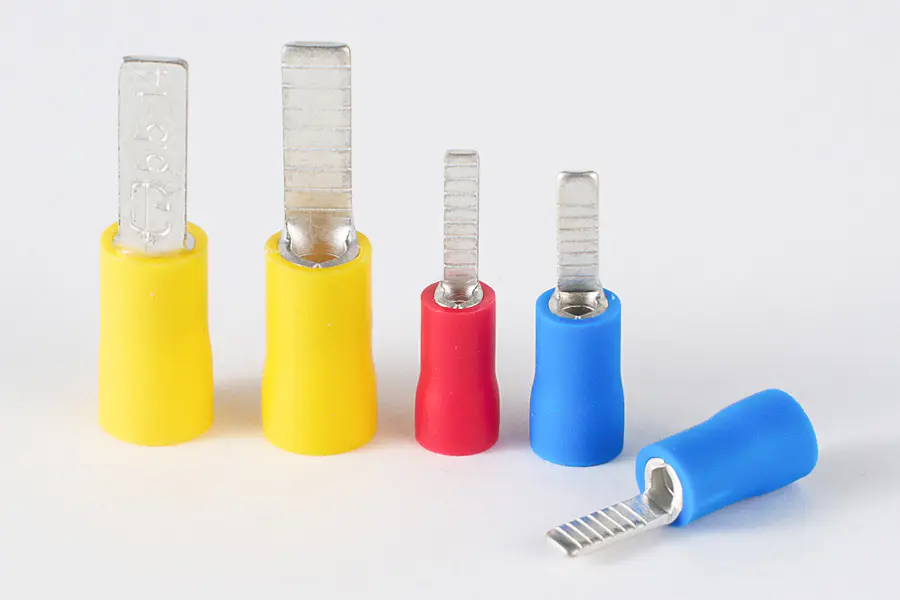
Vinyl insulated blade terminal products commonly follow a color system where red corresponds to smaller 22-16 AWG wire, blue to 16-14 AWG, and yellow to 12-10 AWG, giving installers a fast visual reference for matching terminal to wire size. This color coding exists primarily to prevent gauge mismatches during installation, since a terminal sized for a smaller wire than what's being connected can create the same kind of loose, high-resistance connection that undermines current-carrying performance regardless of the terminal's own rating.
Material and Plating Affect Long-Term Rating Stability
Copper remains the preferred base material for terminal current rating performance because of its conductivity advantage over brass or steel alternatives, though the tin or nickel plating applied over that copper base plays its own role in maintaining performance over time. Plating resists oxidation at the contact surface, and a terminal that develops surface corrosion at its mating point will see its effective current capacity decline even though the underlying copper conductor hasn't changed. This gradual degradation on Blade Terminals Connectors matters more for installations in humid or chemically exposed environments than in clean, dry indoor settings.
Selecting Terminals for the Actual Installation Context
Wire gauge color coding provides a useful initial filter, but matching a terminal to its actual installation context requires looking past the color and the printed rating together. A terminal destined for an engine bay, an outdoor power distribution panel, or a climate-controlled electronics enclosure faces different derating pressures even when nominally rated for the same current. Yueqing Chaodao Electrical Connection Co., Ltd. produces blade terminals across multiple sizes and insulation types, giving buyers a way to match blade width, plating, and insulation material to the specific thermal and environmental demands of a given application rather than relying on a single rating figure to cover every use case.
