


 English
 Español
 Deutsch


Two wires meet end to end inside a small copper sleeve, a tool squeezes the sleeve, and the joint is done. A Butt Splice Connector looks like a part with very little to decide, so buyers tend to ask about insulation color and wire size and stop there. The barrel itself, how it is formed, what it is plated with, and how long it is, has just as much influence on how the crimp behaves.
Seamed and Seamless Barrels
Many barrels are rolled from a flat strip of copper, which leaves a seam along the length of the tube. That seam sits in the zone the crimping die compresses, and a well-formed one closes evenly with the rest of the barrel. A seamless barrel has no such line, so the wall is uniform all the way around. Product ranges that include a seamless non-insulated Butt Splice Connector do so for applications where an even wall under compression is a priority, or where the barrel will be covered with separate sleeving after crimping.
Neither form is better in every case. A seam is a normal feature of a high-volume rolled part, and the choice generally follows the wire range, the tooling, and what the installer expects.
Copper Base and Surface Plating
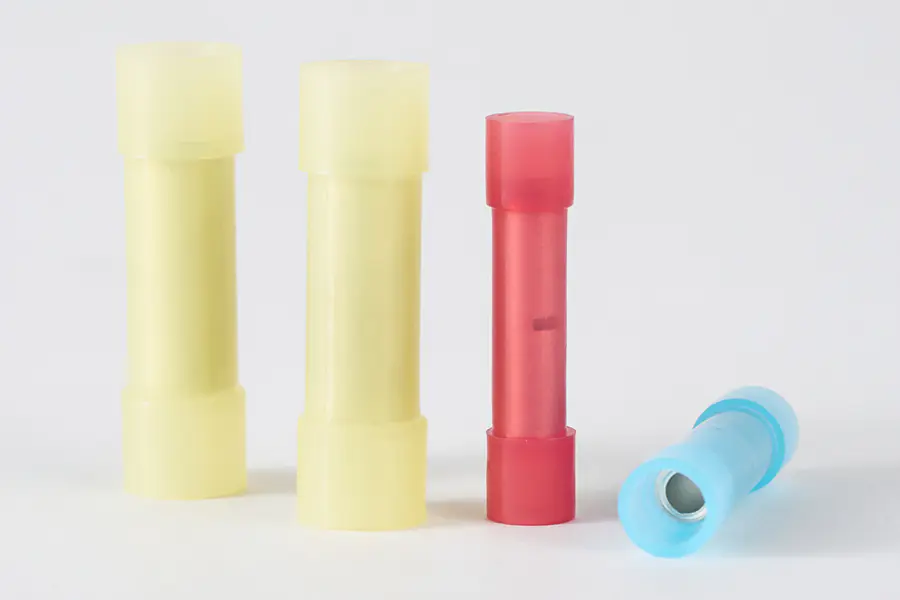
Copper is the base metal for these connectors because it conducts well and deforms predictably under crimping. Bare copper oxidizes over time, so barrels are often plated, and tin or nickel plating is commonly applied to improve corrosion resistance. Tin is a familiar choice for general wiring, while nickel is sometimes selected where higher operating temperatures are expected. Buyers sourcing a Butt Splice Connector for marine, automotive, or outdoor equipment may compare plating type and coverage alongside the insulation, since the plating protects the metal inside the sleeve.
Barrel Length and Grip
A longer barrel gives each conductor more length under compression, while a shorter one suits tight spaces and small junctions. Long-tube PVC-insulated connectors and short-tube insulated models exist for exactly this reason: they serve different spacing and handling needs, not different quality tiers. Barrel length also changes how much stripped wire the installer must prepare, so strip length guidance is worth checking against the barrel in use.
In-Line and Parallel Joins
The classic Butt Splice Connector takes one wire from each end and joins them in a straight line. A short-tube parallel connector instead takes wires from the same side and lays them next to each other, which suits locations where both wires approach from one direction. The two arrangements put the conductors in different positions inside the barrel, so wire range and crimp points differ between them, and a buyer building a range usually lists both types separately.
Insulation as the Outer Layer
Once the barrel is chosen, the insulation is matched to the environment. PVC and nylon sleeves cover general indoor and vehicle wiring, a waterproof heat shrink insulated butt connector adds a sealed layer where moisture is expected, and non-insulated types leave the choice of sleeving to the installer. Heat shrink versions with solder inside are offered for installers who want a soldered joint without a separate sealing step.
Matching Tool and Barrel
Crimping dies are formed for specific barrel sizes, so tool compatibility is part of how a Butt Splice Connector is specified. A distributor offering terminals and crimping tools from the same range can match die and barrel without extra checking, which helps when installers use one tool across several sizes.
What Buyers Typically Compare
For distributors and electrical product importers sourcing this category, useful comparison points include barrel type (seamed or seamless), plating, barrel length, wire range, insulation type, and tool compatibility. Yueqing Chaodao Electrical Connection Co., Ltd., based in the Economic Development Zone of Yueqing City, Zhejiang, lists long-tube PVC-insulated, short-tube parallel, nylon-insulated, seamless non-insulated, and waterproof heat shrink models in its Butt Splice Connector range, alongside cable lugs, copper terminals, quick disconnectors, and terminal kits. Samples crimped with the intended tool let a buyer compare how each Butt Splice Connector type closes and grips the wires before committing to a larger order.
