


 English
 Español
 Deutsch


Two identical connectors crimped onto identical wire can produce two very different joints, one that holds for years and one that pulls apart the moment the cable gets tugged. A crimp connector relies on the metal barrel to carry current, but the strength of the finished joint comes from how that barrel gets deformed around the wire, and that deformation is controlled almost entirely by the crimping die rather than by the connector alone.
What the die actually shapes
Crimping a crimp connector works by compressing the barrel around stripped wire strands until the metal cold-flows and locks around every strand rather than just squeezing the outer layer. A crimp connector achieves this through the specific profile cut into the crimping die, whether that shape is a simple indent, a hexagonal compression or a more complex multi-point pattern. The die profile determines how evenly the compression force spreads across the barrel's circumference, and an uneven spread leaves some strands loosely held while others take on nearly all the mechanical load.
Getting this profile matched to the crimp connector series matters because a die built for one barrel wall thickness will not distribute force correctly on a barrel from a different product line, even when the two connectors look similar from the outside. A crimp connector crimped with the wrong die geometry can look correctly compressed on the outside while the strands inside remain unevenly gripped, a defect that a visual inspection alone will not catch.
Crimp height as the number that actually gets checked
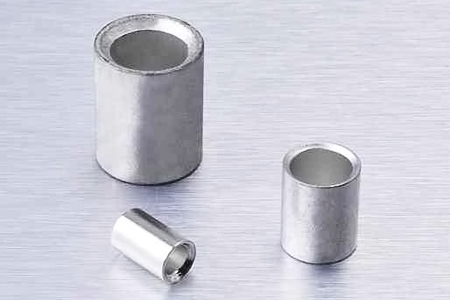
Crimp height, the measured dimension across the compressed barrel after crimping, is the figure that ties the die setting to the finished joint's mechanical integrity. Too little compression and the barrel does not grip the strands tightly enough to resist pull-out force. Too much compression and the metal thins past the point where it can carry current reliably, sometimes cracking the barrel wall outright. A crimp connector crimped to the correct height sits in a narrow window where the metal has cold-flowed enough to lock the strands without over-stressing the barrel material.
This is why crimping tools built for production use include a calibrated adjustment rather than a single fixed setting, letting an operator dial in the exact compression a given wire gauge and barrel size calls for. A crimp connection made without checking this height against the connector manufacturer's specification is little more than a guess, even when the crimping tool itself is well maintained and the connector is correctly rated for the wire.
Pull-out force as the practical test
Once a joint is crimped, pull-out force testing gives a direct read on whether the die and crimp height actually produced a mechanically sound connection. A sample is pulled under a controlled, increasing load until the wire either slips free of the barrel or breaks outside it, and the load at failure gets compared against the minimum the connector's specification calls for at that wire gauge. A crimp connector that fails below the specified pull-out force points to a die or height problem upstream, not necessarily a defect in the connector itself.
Testing a sample from a production run of crimp connection joints, rather than assuming every crimp behaves identically to the earlier one checked, catches drift that can creep in as a die wears or as an operator's technique shifts across a long shift. A crimp connection that passed testing at the start of a run can still fail later once the die has worn enough to change how it compresses the barrel, which is why periodic sampling matters as much as the initial setup check.
Matching wire strand count to barrel design
Wire construction adds another variable the die has to accommodate. A solid conductor and a finely stranded conductor of the same gauge behave differently under compression, since the finely stranded wire has more individual surfaces that need to lock together rather than one continuous core deforming as a single mass. A crimp connector barrel designed with finely stranded wire in mind often uses a longer barrel or a different internal profile than one intended primarily for solid or coarsely stranded wire, giving the strands more surface area to grip.
Buyers specifying crimp connector parts for a new assembly benefit from confirming the barrel design matches the actual wire construction going into it, rather than assuming any connector rated for a given gauge will perform identically regardless of strand count. Matching barrel design, die profile and crimp height together, rather than treating any one of the three as sufficient on its own, is what turns a correctly rated connector into a joint that actually holds up under the pull and vibration a finished assembly sees in service.
