


 English
 Español
 Deutsch


Inside a junction box above a boiler room or beside a vehicle engine, a wire connection sits through temperature swings that a living-room installation never sees. The metal inside the connector copes with heat easily. The plastic around it decides whether the connection stays sealed and insulated. Yueqing Chaodao Electrical Connection Co., Ltd. in Yueqing City, Zhejiang, builds its Closed End Crimp Wire Connectors with a nylon housing chosen for this job, and the temperature range of that housing shapes where the connectors can be used.
Why the Housing Material Is Nylon 66
The outer shell of Closed End Crimp Wire Connectors is made of PA66, a high-strength nylon known for wear resistance and stability across temperature changes. The PA66 housing withstands roughly -40°C to 120°C, which covers cold storage rooms, outdoor enclosures, and warm equipment cabinets. A weaker plastic would soften in the upper range or crack in the lower one, and a cracked shell leaves the live conductor exposed. The housing insulates the joint, and it also protects the joint from moisture, dust, and corrosion.
The Closed End Seals the Wire Tip
A closed-end design caps the connection at one end. Water and dust that would reach an open splice have no path to the conductor tip, and the stripped copper stays inside a covered chamber. For Closed End Crimp Wire Connectors, this matters in damp locations, such as outdoor lighting, irrigation controls, and garden equipment, where an uncovered connection corrodes quickly. The cap form also removes a sharp wire end that could snag on other cables during installation. Closed End Crimp Wire Connectors suit tight spaces because the finished joint is compact and smooth.
Copper Tube or Spring Inside
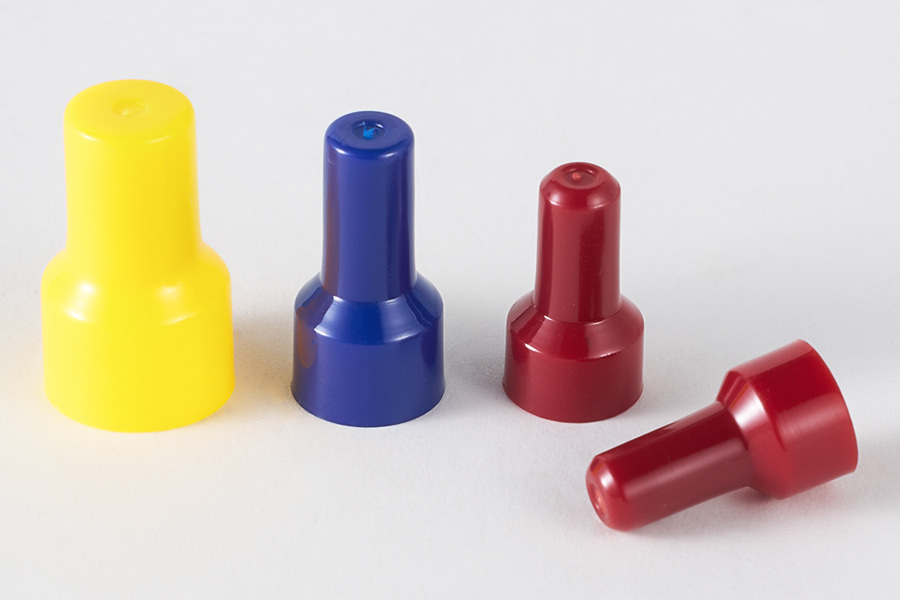
Inside the housing, a copper tube or a spring grips the wire. The metal in these Closed End Crimp Wire Connectors handles the electrical connection and the clamping force, while the PA66 housing holds the metal in position and insulates it, and the same PA66 housing resists abrasion during handling. Heat also affects how a plastic shell grips the cable insulation, so a shell that stays dimensionally stable at 120°C keeps the cap seated on the wire through months of thermal cycling. Copper conducts well and resists loosening under vibration when the grip is formed correctly. A spring element adds adjustable clamping, so a connector tightens around the conductor as it is twisted in. The metal and plastic have to work as a pair: a shell that expands more than the insert would loosen the grip, so the match of materials is a design decision, not an afterthought.
Four Models for Different Hands and Jobs
The range of Closed End Crimp Wire Connectors includes four models: the Colorful Screw On Wire Connector, the Double Wing Screw On Wire Connector, the Close End Flat Connector, and the Clear Nylon Close End Connector. Color on the Colorful model helps electricians separate sizes at a glance. The double wing shape gives fingers extra leverage when twisting the connector on. The flat connector suits spaces where a round body would not fit behind a panel. The clear nylon version shows the conductor through the shell, so an installer can confirm that the wire is fully inserted. One range of Closed End Crimp Wire Connectors covers these needs without forcing an installer to adapt a single design to every task.
Flame-Retardant Options
Some models use flame-retardant material. In enclosures packed with wiring, a flame-retardant shell slows the spread of a fault if a connection overheats. Specifying that option matters for panel builders and equipment makers who answer to fire-safety rules in their own markets. A material choice of this kind adds little to the size of the connector but a good deal to its margin of safety. Yueqing Chaodao Electrical Connection Co., Ltd. offers flame-retardant materials on selected models, so a distributor reviewing Closed End Crimp Wire Connectors can confirm which version is intended for the project.
Fitting Into a Wider Connection Range
The factory also produces butt splice connectors, ring, spade, pin, blade, and hook terminals, insulated cord end terminals, quick disconnectors, terminal kits, and terminal tools. A distributor stocking Closed End Crimp Wire Connectors can pair them with these items for contractors who handle both new wiring and repair work. A single supplier for connectors, terminals, and tools shortens the ordering process, and it keeps the quality and appearance of the products consistent across the whole shipment.
