


 English
 Español
 Deutsch


A cable lug looks like a simple piece of metal, yet the joint it forms carries the full current of the circuit. One end grips the conductor, and the other bolts to a busbar, a breaker, or a battery post. The bolted end decides how much of the lug actually touches the mating surface. Yueqing Chaodao Electrical Connection Co., Ltd. in Yueqing City, Zhejiang, makes Cable Wire Lugs in copper and brass, and the shape of that bolted end, known as the palm, receives as much attention as the barrel.
The Palm Is Where Current Changes Direction
Current travels through the cable, enters the barrel, crosses the neck, and spreads into the palm before it passes to the terminal surface. A palm that sits flat against a mating plate offers a wide, even path, and that property is what keeps it so. A palm that bows or twists touches only at a few points, and current crowds through those points, which raise the temperature locally. For Cable Wire Lugs carrying heavy loads, palm flatness is a practical measure of how well the joint will perform once the bolt is tightened.
Single Hole Copper Lugs
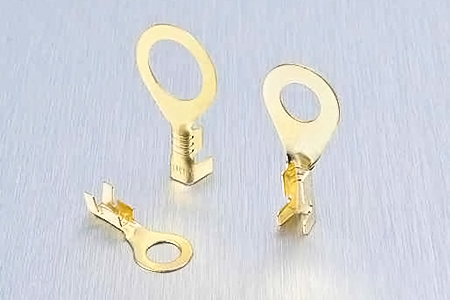
The Cable Wire Lugs range at Yueqing Chaodao Electrical Connection Co., Ltd. includes the Single Hole Copper Lug in A Class. A single bolt hole centers the load and keeps the installation direct, which suits equipment where a lug attaches to one stud. Copper conducts well and bends predictably under the press, so the palm can be formed flat and punched cleanly. Burrs left around a punched hole would lift the palm away from the mating surface, so the hole edge is finished as part of the same operation. Good palm flatness on a single hole lug lets the bolt pull the whole surface down instead of one edge.
Non-Insulated Copper Lugs
The Non-Insulated Copper Lug in B Class leaves the barrel bare, which is common in Cable Wire Lugs meant for use with separate sleeves. Installers choose their own covering, such as heat-shrink tubing, once the crimp is complete. A bare barrel also lets the installer see the conductor strands enter the lug and confirm the cable is fully seated before crimping. The palm on this lug follows the same palm flatness requirement as an insulated type, because insulation does nothing to correct a poor contact surface. A Cable Wire Lugs line that includes both bare and covered options gives electricians a choice between a lower-cost bare lug and a complete finished joint.
Brass for the Ring Terminal
Among Cable Wire Lugs, the Ring Brass Cable Lug uses brass in place of copper. Brass is harder than copper, so a brass ring holds its shape when the bolt is tightened and resists deforming under repeated assembly. That stiffness suits connections that are opened and closed during maintenance. The tradeoff is conductivity, which is lower than that of copper, so brass rings are chosen for the applications where mechanical strength and corrosion behavior matter alongside current capacity. Offering copper and brass in one range of Cable Wire Lugs lets an importer match the material to the job rather than adopt one material for every installation.
Checking Flatness in Production
At Yueqing Chaodao Electrical Connection Co., Ltd., formed lugs are checked against a flat reference surface before packing. A palm that rocks on the plate, or shows a visible gap along one edge, is set aside. The barrel gets inspected separately for roundness and wall consistency, because a crimp die closes evenly only around a uniform barrel. These two checks cover both sides of the lug: the part that grips the cable and the part that meets the terminal. Reviewing both sides on every Cable Wire Lugs batch keeps the finished joint reliable on the installation site.
A Broader Terminal Range From One Supplier
Lugs are one part of a larger product line. The factory also makes butt splice connectors, closed end connectors, copper blade, pin, ring, spade, and hook terminals, cord end terminals, quick disconnectors, terminal kits, terminal tools, and wiring accessories. A distributor ordering Cable Wire Lugs can add matching crimp tools and terminal kits to the same shipment, so electricians receive everything needed for a complete connection. Lugs, splice connectors, and tools made in one factory also share consistent finishing, which helps a contractor who works through a whole job in one sitting. The spread of products under one roof also simplifies catalog planning for wholesalers who serve panel builders, vehicle workshops, and maintenance teams.
