


 English
 Español
 Deutsch


A service technician opens a motor control cabinet to swap a contactor and finds a dozen conductors landed on screw terminals in a tight row. Pulling each screw fully out risks dropping it into the wiring below, so the technician loosens each one by a turn and slides the terminals free. That routine explains why Electrical Hook Terminals stay in use on panels, appliances and machinery where connections need to be opened again.
How the Hook Works
The curved end of the terminal hooks around a stud or screw. Because the opening faces sideways, the terminal slips on after the screw is loosened rather than removed, and tightening the screw clamps the hook against the terminal block. A ring terminal has a closed loop and needs the fastener taken out completely, which is the difference that matters during maintenance. Electrical Hook Terminals also resist slipping sideways while the screw is turned, so the wire stays where the installer placed it.
Open and Closed Hook Designs
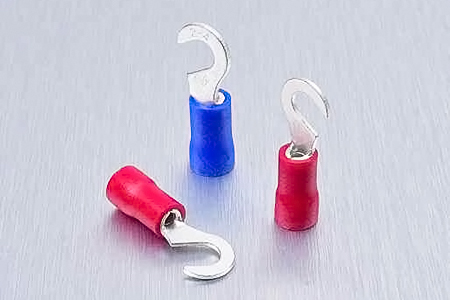
Hook shapes fall into two main groups. A closed hook forms a nearly complete circle and holds firmly in high-vibration locations such as engine compartments and industrial machinery. An open hook keeps a slight gap, so it goes on and off without fully unscrewing the stud, which suits test equipment, tight enclosures and temporary installations. Specialised forms, such as right-angle hooks, address limited clearance in compact assemblies and circuit board wiring. Choosing between these forms of Electrical Hook Terminals comes down to how often the connection is opened and how much movement it sees.
Insulated and Non-Insulated Types
Insulated hook terminals carry a colour-coded PVC or nylon sleeve that provides isolation, strain relief and protection against moisture and dust, which helps in crowded panels. Non-insulated versions are bare metal, compact and cost-effective, and they work where heat shrink tubing is added later or where several terminals stack on one stud. We produce vinyl insulated, nylon insulated and non-insulated Electrical Hook Terminals, so one design can serve both enclosed control cabinets and exposed wiring.
Materials and Plating
Copper is the usual base metal because of its conductivity, while brass or steel appear where mechanical strength matters more. Plating follows the environment: tin for general corrosion resistance, nickel where temperatures run high, and silver where low contact resistance counts. A spectrometer confirms the alloy before stamping, and hardness testers check that the formed hook holds its shape under clamping load. Material control of this kind keeps Electrical Hook Terminals consistent from lot to lot.
From Strip to Finished Terminal
Production runs in four stages. A continuous metal strip feeds a progressive die, which punches the outline, pierces the centre and forms the hook and barrel in one pass. The terminals then travel on their carrier strip through cleaning and an electroplating bath. For insulated types, an injection tool moulds the PVC or nylon sleeve around the barrel. The final stage inspects dimensions and visible defects before the terminals are cut from the strip and packed on reels or in bulk bags. Keeping the terminals on a carrier strip until the last step protects the plating, and each stage of that sequence applies to Electrical Hook Terminals of any size.
Stud Sizes and Wire Range
The hook opening is sized to the screw or stud, with M3.5, M4 and M5 among the common choices, while the barrel is sized to the wire gauge and carries the colour code on insulated types. A hook that is too wide for the screw can slide off under vibration, and one that is too narrow will not seat under the screw head. We can develop Electrical Hook Terminals to a customer's drawing or sample when a standard size does not match the hardware, which keeps the same quick-service benefit in equipment built around unusual stud dimensions.
