


 English
 Español
 Deutsch


Vinyl Insulated Lipped Blade Terminals look like ordinary male blades on a quick look, yet the small lip along the blade edge changes how the part behaves once it is plugged in. The lip adds retention and stiffness, and the vinyl sleeve adds insulation and strain relief behind the crimp. Together they suit equipment that shakes, swings or gets serviced often.
What the Lip Does
A plain blade relies on friction alone to stay inside a receptacle or terminal block. The lip adds a mechanical stop, so the blade seats at a defined depth and resists sliding out when the equipment moves. It also stiffens the edge, which reduces bending when a blade is pushed in at a slight angle. Engines, compressors, pumps and motor housings all produce the repeating movement that gradually works a joint held by friction alone loose, and Vinyl Insulated Lipped Blade Terminals give that joint extra retention without adding a separate fastener.
Why Vinyl Suits the Sleeve
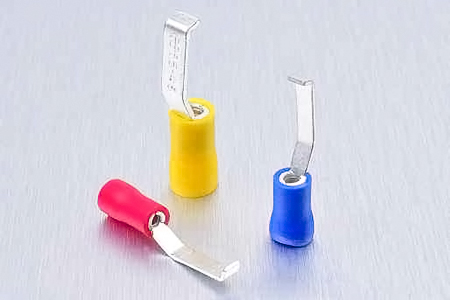
Vinyl is flexible, so the sleeve bends with the wire instead of cracking at the barrel. It resists moisture, oil and many common chemicals, and it takes colour well, which lets installers identify the wire range from the sleeve. A continuous rating near 75 °C is commonly quoted for PVC, enough for appliance, panel and general machinery wiring. We produce Vinyl Insulated Lipped Blade Terminals as a single crimp type and as a double crimp type, where a second crimp zone clamps the wire insulation and holds the sleeve in place.
Variants Within the Family
Within Vinyl Insulated Lipped Blade Terminals, the sleeve construction changes with the environment:
- Standard vinyl gives basic protection against dust, moisture and wear, and suits appliance and residential wiring.
- Double crimp vinyl adds an insulation grip for harnesses that are pulled and bent during assembly.
- Nylon insulated versions use a harder, thinner sleeve that tolerates more heat.
- Heat shrink versions seal the joint against water, dust and chemicals for industrial machinery and marine wiring.
Non-insulated lipped blade terminals sit alongside these in the range. They fit assemblies where a housing already encloses the connection, while open wiring is better served by the insulated types, since bare metal is more exposed to corrosion and accidental contact. The lip geometry stays the same across all of them, so a Vinyl Insulated Lipped Blade Terminals design can move from a standard sleeve to a heat shrink sleeve without changing the receptacle.
Metal and Plating
The base metal is copper or brass, chosen for conductivity and spring behaviour. Tin plating is common, and nickel or other coatings can be applied for added oxidation resistance. Plating matters at the contact surface, because a thin or uneven layer wears quickly when a terminal is plugged and unplugged repeatedly. Vinyl Insulated Lipped Blade Terminals made from plated copper keep a stable contact surface through those cycles.
Crimp Quality Checks
Crimp quality decides whether the terminal outlasts the vibration it is built for. The wire strands should be visible at the front of the barrel, the seam should sit on the correct side of the die, and the insulation grip should hold the sleeve without cutting it. Pull tests confirm the crimp holds the conductor, and pressure testers and hardness testers support those checks on finished lots, while a spectrometer verifies the copper alloy before it is stamped. Each batch of Vinyl Insulated Lipped Blade Terminals passes through that sequence.
Sizes and Custom Requests
Sizes follow wire gauge from small control wiring to heavier power circuits, and we can develop terminals to a customer's drawing or sample when a standard size does not fit the equipment. That flexibility means Vinyl Insulated Lipped Blade Terminals can be matched to a particular receptacle or terminal block without changing the connector design.
