


 English
 Español
 Deutsch


A Fully Insulated Female Disconnector wraps the barrel and the receptacle in a plastic sleeve, so no bare metal is exposed once the terminal is crimped and pushed onto a male tab. The metal core is usually tin-plated brass or copper, but the sleeve decides how the part behaves in service. Vinyl, nylon and heat shrink are the three materials in common use, and each one suits a different wiring environment.
What the Sleeve Does
The sleeve on a Fully Insulated Female Disconnector does three jobs at once. It isolates live metal from neighbouring terminals and from a technician's fingers. It supports the wire just behind the crimp, so bending stress is absorbed by the plastic instead of the conductor strands. It also carries the colour code that tells an installer the wire range at a glance, with red for 22 to 16 AWG, blue for 16 to 14 AWG and yellow for 12 to 10 AWG following the usual convention.
Tab width is the other basic dimension. Receptacles are commonly made for 2.8 mm, 4.8 mm and 6.3 mm male tabs, and the shroud around the opening keeps the mated pair covered after the connection is plugged together.
Vinyl Sleeves
Vinyl, or PVC, is soft and flexible, and it resists moisture, oil and many household chemicals. A continuous rating around 75 °C is commonly quoted for it, which covers appliance wiring, lighting circuits, switches and general control panels. We produce vinyl versions as a straight Fully Insulated Female Disconnector, as a bullet-shaped receptacle and as double crimp types, so the same wire range can be matched to different tab fits and strain relief needs.
Nylon Sleeves
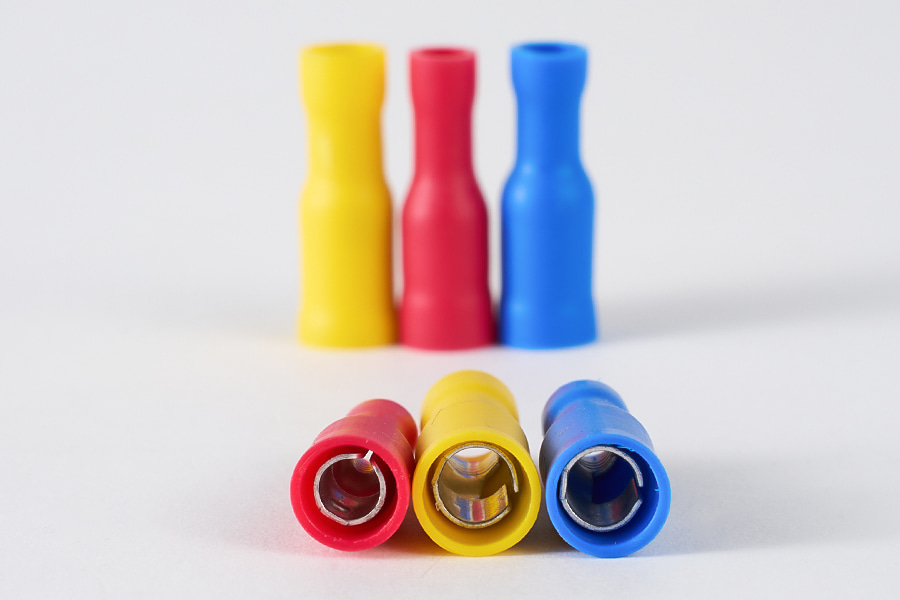
Nylon is harder than vinyl and can be moulded with a thinner wall. A rating near 105 °C is commonly cited, and the tough surface resists abrasion when terminals are pushed through crowded wiring channels. A nylon Fully Insulated Female Disconnector also keeps its outer diameter small, which helps when several receptacles sit side by side on a connector header. Nylon fully insulated female terminals are available from us in straight, bullet and Y-type forms. The firmer material calls for a crimp die matched to the sleeve, because a die set too tight can crack the wall.
Heat Shrink Sleeves
Heat shrink adds a step after crimping. A heat gun shrinks the tubing around the wire insulation, and the adhesive lining flows into the gap to seal the joint against water and dust. A heat shrink Fully Insulated Female Disconnector therefore suits vehicles, boat wiring and outdoor lighting, where spray and condensation reach the connection. We make both straight and bullet types in heat shrink.
Crimp Features That Matter
A double crimp terminal has two crimp zones that work together. The wire barrel crimp grips the conductor for electrical contact, while the insulation grip clamps the wire insulation to hold the sleeve in position. When the insulation grip is weak, the sleeve can creep back along the wire during repeated plugging and unplugging and expose the barrel. A Fully Insulated Female Disconnector with a double crimp design spreads the pull load across both zones.
Each Fully Insulated Female Disconnector leaving the line is checked on an optical projector for sleeve and barrel dimensions. Temperature rise testers and high and low temperature humidity chambers show how the plastic and the contact behave under load and cycling, and the company's products have received CE, RoHS and UKAS approval.
Matching Sleeve to Job
A short comparison frames the choice:
- Vinyl suits general wiring where flexibility and cost count.
- Nylon suits dense panels and cabinets that run warm.
- Heat shrink suits wet, outdoor and vehicle wiring.
Colour coding stays consistent across the three families, so a mixed harness can use two materials without confusing wire sizes. A Fully Insulated Female Disconnector in any of them keeps the same mating geometry, which makes swapping one sleeve type for another a matter of selecting the correct wire range.
