


 English
 Español
 Deutsch


Butt Splice Connector is commonly used in wiring systems where two conductors need to be joined in a straight line. In many production and maintenance environments, its behavior is not judged at the moment of installation, but during long-term operation when vibration, heat, and mechanical stress begin to influence connection stability.
On industrial wiring lines, a wire splice terminal is often evaluated not by appearance, but by how consistently it maintains contact after repeated movement or environmental changes.
Connection Stability Changes After Installation
At the moment of crimping, most connections appear stable.
Wires sit tightly inside the connector.
Insulation covers the joint evenly.
The connection feels mechanically firm.
However, stability is not only determined at installation. Over time, small changes in tension and vibration exposure may influence how a Butt Splice Connector behaves inside a working harness.
Vibration Exposure Creates Subtle Movement
In real equipment environments, wiring rarely stays completely still.
Machines operate continuously.
Frames vibrate slightly during running cycles.
Harnesses shift due to thermal expansion and movement.
These small forces gradually act on each wire splice terminal, even if the connector itself does not show visible damage.
Crimp Quality Differences Become Visible Later
Two connectors may look identical after installation.
But internal crimp density may differ slightly depending on tool pressure, wire position, or operator handling.
During operation, these differences may not appear immediately.
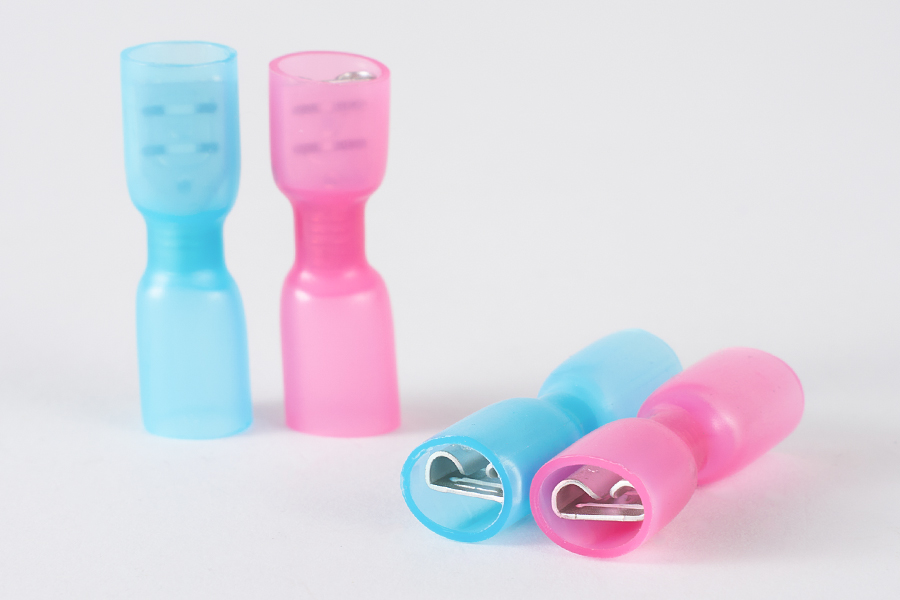
They often become noticeable only after repeated thermal cycles in a Butt Splice Connector system.
Thermal Cycling Influences Contact Behavior
Electrical systems do not maintain constant temperature.
During operation, heat rises.
After shutdown, cooling begins.
This cycle repeats many times.
Each cycle creates slight expansion and contraction inside the connection point.
Over time, this can influence how tightly a wire splice terminal maintains internal contact pressure.
Wire Movement Inside Harness Routing
Wire routing is not always fixed in a rigid position.
Some harnesses are bundled tightly.
Others allow partial movement between clips.
In areas with frequent movement, connectors may experience micro-stress along the joint area.
This is especially relevant when evaluating long-term behavior of a Butt Splice Connector in mobile or vibrating equipment.
Contact Resistance Variation Appears Gradually
In stable conditions, resistance remains consistent.
But under combined influence of vibration and temperature cycling, slight variation may appear.
This does not always cause immediate failure.
Instead, it shows up as intermittent performance changes in downstream devices connected through a wire splice terminal.
Environmental Exposure Influences Long-Term Stability
Moisture, dust, and oil exposure vary depending on installation location.
Some connectors are placed inside sealed harnesses.
Others are closer to external environments.
Even when insulation is present, long-term exposure can influence surface conditions around a Butt Splice Connector, especially in harsh operating environments.
Harness Layout Affects Stress Distribution
Wire layout is not always symmetrical.
Some connectors are positioned near bending points.
Others are fixed near rigid mounting areas.
Stress is not evenly distributed across all joints.
This uneven distribution leads to different aging behavior among multiple wire splice terminal points in the same system.
Maintenance Observations Are Often Indirect
In most systems, technicians do not inspect every connector individually.
Instead, they rely on system behavior:
intermittent signal changes
unexpected voltage drop
unstable device response
These symptoms often lead to inspection of wiring joints, including Butt Splice Connector points within the harness.
Real Reliability Depends On Combined Factors
Connector stability is not controlled by a single variable.
Crimp quality, vibration level, thermal cycling, and wire routing all interact together.
When variations appear, they are usually the result of combined mechanical and environmental influences rather than one isolated issue in a wire splice terminal system.
Field Behavior Differs From Installation Expectation
A connection that appears stable during installation may behave differently after extended operation.
This difference is not always immediate.
It develops slowly across repeated use cycles.
That is why real-world evaluation of a Butt Splice Connector is often based on long observation rather than initial inspection results.
